Simplifying a Boolean expression by hand can get messy fast. Algebraic simplification works, but it's easy to miss a shorter form, especially once a function has four or five inputs. A Karnaugh Map gives you a grid-based way to spot those simplifications visually, without working through algebra rule by rule.
What Is a Karnaugh Map?
A Karnaugh Map, usually shortened to K-Map, is a grid that represents every possible output of a Boolean function for every combination of its inputs. Each cell in the grid corresponds to one row of a truth table (learn how to convert a truth table to a Karnaugh Map). Instead of scanning down a column of 1s and 0s, you look at a two-dimensional layout where inputs that differ in only one variable sit right next to each other.
That layout is the whole point. A truth table lists outputs in a fixed order, so two rows that are logically close to each other might be far apart on the page. A K-Map rearranges those same values so that logical closeness matches physical closeness. Once related cells are neighbors, patterns become visible: a block of 1s across several cells usually means part of the expression can be dropped entirely.
Why Are Karnaugh Maps Used?
The main reason to use a K-Map is to reduce a Boolean expression to a simpler form. A raw expression built directly from a truth table often includes far more terms and literals than necessary. Grouping cells on a K-Map removes the variables that don't actually affect the output within that group, leaving a shorter, equivalent expression.
A simpler Boolean expression is usually easier to implement as a logic circuit, since fewer terms generally means fewer gate inputs to wire up. That said, the relationship between a simplified expression and the final circuit isn't automatic — real implementations depend on the target technology, existing gate libraries, and other constraints, so a K-Map won't guarantee the fewest physical gates in every case. What it reliably gives you is a smaller, cleaner algebraic form and a much better visual grip on how the inputs relate to the output.
How a K-Map Works
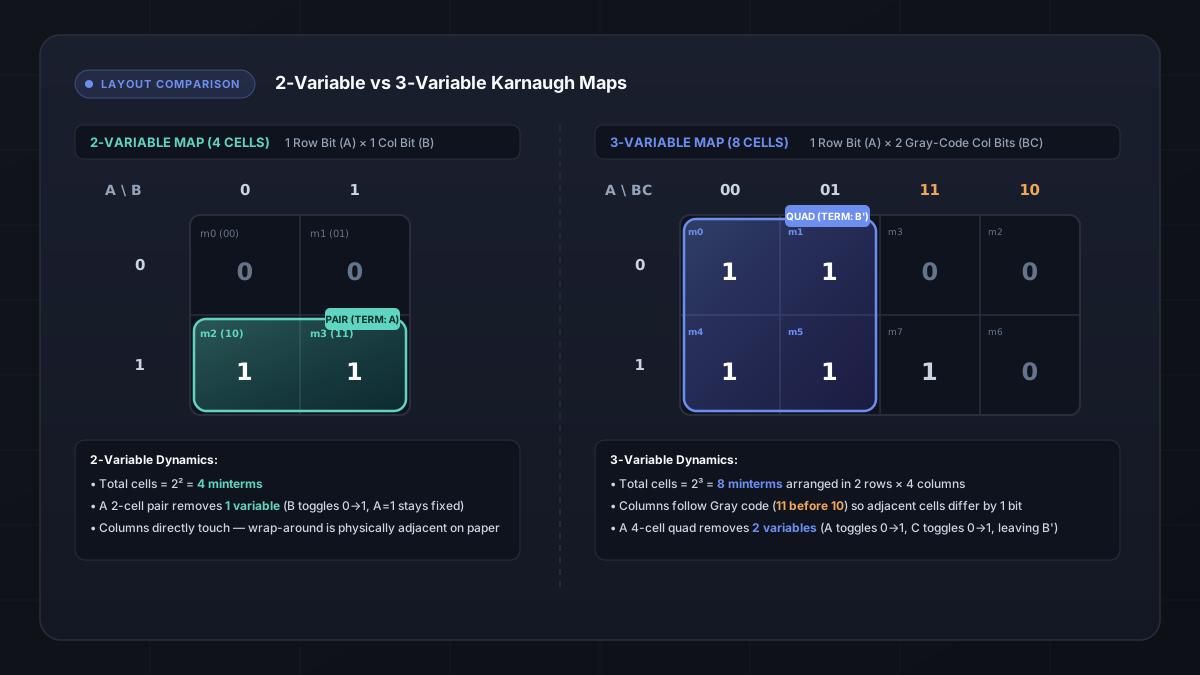
Each cell in a K-Map stands for one specific combination of input values. The rows and columns aren't labeled in plain binary order — they follow Gray code, where each step from one row or column to the next changes exactly one bit. That's not a stylistic choice. It's what makes adjacent cells differ in only one variable, which is the entire mechanism the grid relies on.
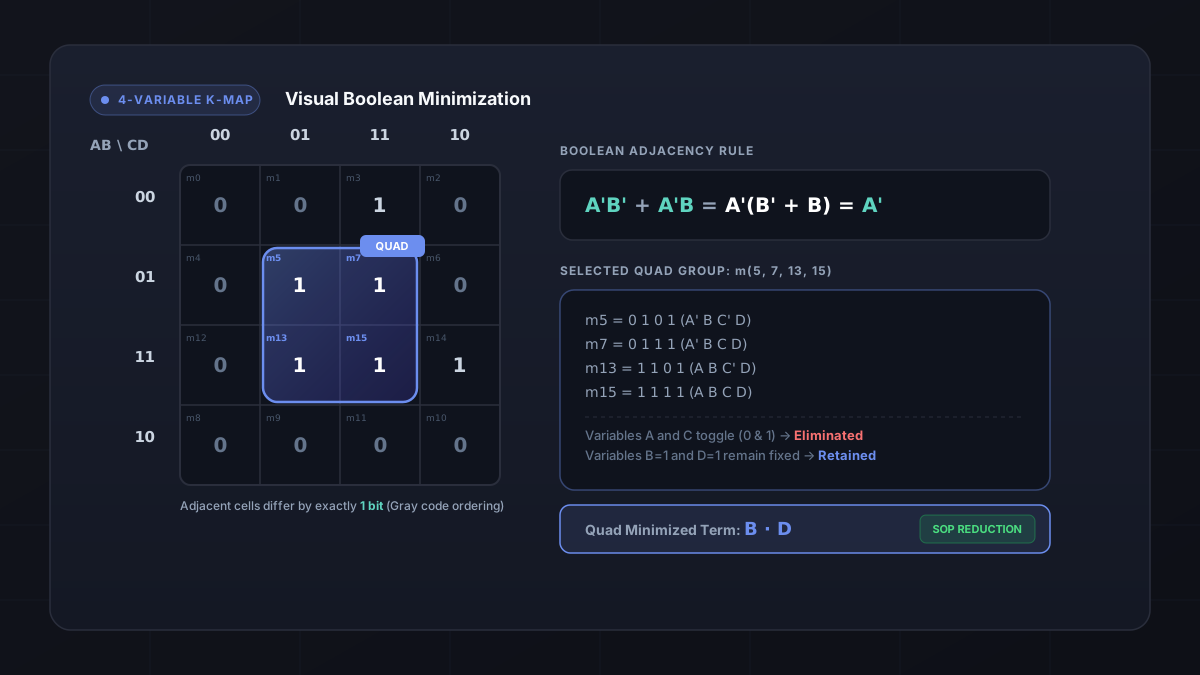
Take a small example. Suppose two neighboring cells hold the terms A'B' and A'B. They differ only in B — one has B, the other has B'. Since A' is common to both and B covers both its own states, the pair collapses to A' alone:
A'B' + A'B = A'
That's the basic move behind every K-Map simplification, just repeated across bigger groups.
Understanding K-Map Groups
Cells are combined into groups, and each valid group size is a power of two: 1, 2, 4, 8, or 16 cells. A group of 2 is usually called a pair, a group of 4 a quad, and a group of 8 an octet. The bigger the group, the more variables drop out of the resulting term — a pair removes one variable, a quad removes two, an octet removes three, and so on. To learn all grouping shapes and edge conditions, see our dedicated guide to Karnaugh Map grouping rules.
A few things trip people up here. Groups are allowed to overlap, and reusing a cell in more than one group is normal and often necessary to reach the simplest overall expression. The grid also wraps around at its edges: the leftmost column is adjacent to the rightmost column, and the top row is adjacent to the bottom row. In a 4-variable map, the four corner cells count as adjacent to each other too, purely through that wrap-around behavior, even though they're nowhere near each other on the page.
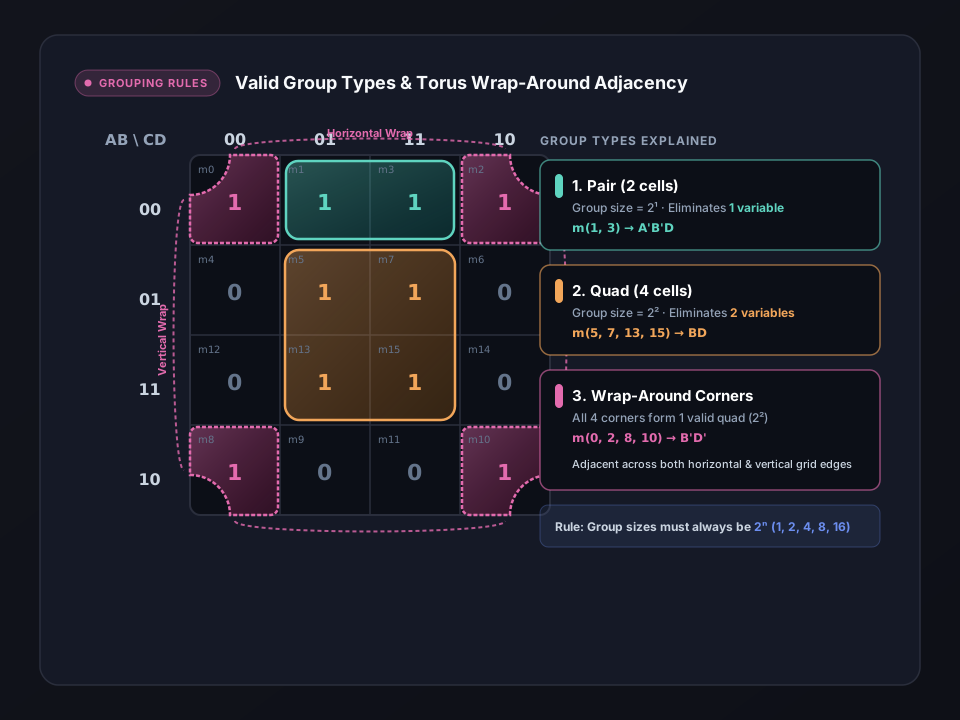
The four corner cells of a K-Map are adjacent through wrap-around, even though they sit at opposite ends of the grid.
What Does X Mean in a Karnaugh Map?
An X in a cell marks a don't-care condition — an input combination whose output was never specified, usually because that combination can't occur in practice or its result genuinely doesn't matter. You're free to treat each X as either a 1 or a 0, whichever helps form a larger group, and you're just as free to leave it out of a group entirely if it doesn't help.
As a small example, say a circuit only ever receives inputs where at least one of two select lines is active, so the combination where both are inactive never happens. That row can be marked X. If treating it as a 1 lets two separate pairs merge into one quad, use it that way. If it doesn't help, ignore it.
SOP and POS in Karnaugh Maps
A K-Map can be read in two directions, depending on which output value you group around. Sum-of-Products, or SOP, groups the 1 cells and produces an expression made of ANDed terms joined by OR — something like:
A'B + BC
Product-of-Sums, or POS, does the opposite: it groups the 0 cells and produces ORed terms joined by AND, such as:
(A + B')(B + C)
Both describe the same underlying function; they're just built from opposite starting points. To see a detailed comparison of grouping 1s versus 0s, read our full guide on SOP vs POS in Karnaugh Maps. Which one you pick usually comes down to which form is shorter, or which matches the logic gates you actually have available.
2, 3, 4, and 5 Variable K-Maps
The number of cells in a K-Map doubles with every added variable. A 2-variable and 3-variable Karnaugh Map uses 4 or 8 cells to teach foundational grouping and Gray code, while a 4-variable Karnaugh Map has 16 arranged as a 4×4 grid.
At 5 variables, there are 32 possible input combinations. A 5-variable K-Map is often represented as two linked 16-cell maps, which makes adjacency and grouping harder to track by eye.
Complexity grows quickly past four variables. Adjacency gets harder to track by eye, especially with wrap-around and overlapping groups involved, which is part of why 5-variable maps are where people often start reaching for software help instead of grouping everything by hand.
A Simple Karnaugh Map Example
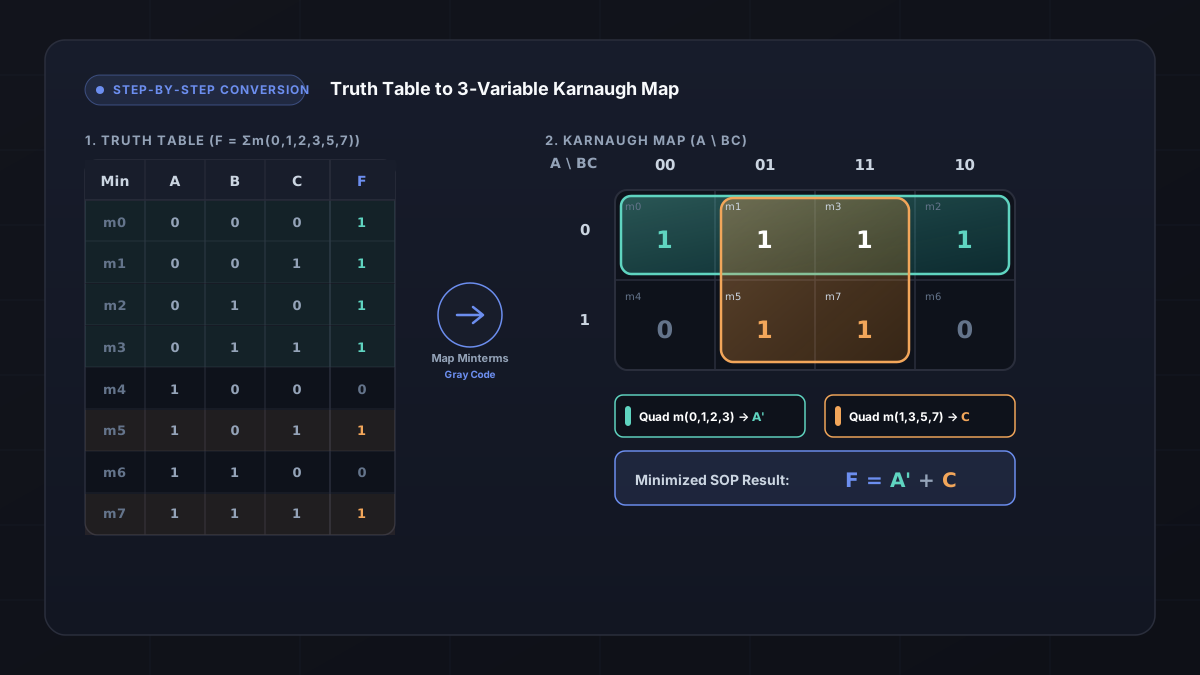
Here's a 3-variable function defined by its minterms:
F(A, B, C) = Σm(0, 1, 2, 3, 5, 7)
Start with minterms 0, 1, 2, and 3. These fill the entire row where A = 0, so they form a quad. Because A stays at 0 throughout that group while B and C change, the quad simplifies to:
A'
There is another useful quad made from minterms 1, 3, 5, and 7. In all four of those cells, C = 1 while A and B change. That group therefore simplifies to:
C
Notice that minterms 1 and 3 appear in both groups. This overlap is valid and helps produce the smaller expression.
Combining the two terms gives:
F = A' + C
The two overlapping quads cover every required 1 in the function.
Common K-Map Mistakes
A handful of errors come up again and again:
- Grouping cells in sizes that aren't powers of two, like a group of 3 or 6.
- Missing edge adjacency, especially the wrap between the first and last column or row.
- Settling for two small groups when a single larger group was available.
- Treating a don't-care X as if it were a required 1, and forcing it into every group.
- Mixing SOP and POS logic in the same pass, grouping some cells around 1s and others around 0s.
- Laying out rows or columns in plain binary order instead of Gray code, which breaks adjacency entirely.
When Should You Use a Karnaugh Map?
Manual K-Maps work well for 2, 3, and 4-variable functions, where the grid stays small enough to scan by eye and mistakes are easier to catch. At 5 variables, the additional cells and wrap-around relationships make manual grouping slower and more error-prone, and it's easier to overlook a valid group.
That's usually the point where checking your work against an automated tool becomes useful, particularly for coursework or circuit designs where an overlooked group can change the result.
Karnaugh Map Solver supports functions from 2 through 5 variables, so it can be used to verify a manual grouping or work through a larger case directly.
Frequently Asked Questions
What is a Karnaugh Map used for?
It's used to simplify Boolean expressions and logic functions by grouping related input combinations visually instead of working through algebraic identities by hand.
Is a K-Map the same as a truth table?
They hold the same information, but a truth table lists it as rows in a fixed order, while a K-Map rearranges it into a grid where logically adjacent inputs sit next to each other.
Why does a Karnaugh Map use Gray code?
Gray code ensures each step between neighboring rows or columns changes exactly one bit. That's what makes adjacent cells differ in only one variable, which is what grouping depends on.
Can K-Map groups overlap?
Yes. The same cell can belong to more than one group, and doing so is often necessary to reach the simplest possible expression.
What does X mean in a K-Map?
X marks a don't-care condition — an input combination with no required output. It can be treated as either a 1 or a 0 when that helps form a better group, or ignored if it doesn't help.
What is the difference between SOP and POS?
SOP groups the 1 cells into an ANDed-then-ORed expression. POS groups the 0 cells into an ORed-then-ANDed expression. Both can represent the same Boolean function.