Filling in a Karnaugh Map is usually the easy part. Deciding which cells to group is where most mistakes happen — a group that looks fine at first glance can be the wrong shape, the wrong size, or missing a wrap-around connection that isn't obvious on a flat grid.
Groups aren't arbitrary shapes drawn around whatever 1s happen to sit near each other. They follow specific rules around size, adjacency, overlap, and edge wrapping, and getting any one of those wrong changes the simplified expression you end up with.
This article covers those rules directly, without re-explaining what a K-Map is from scratch.
The Basic Rule: Group in Powers of Two
Every valid group size is a power of two:
- 1 cell — singleton
- 2 cells — pair
- 4 cells — quad
- 8 cells — octet
- 16 cells — group of sixteen
In a 5-variable map, a 32-cell group is also possible when all 32 cells are eligible for the chosen SOP or POS grouping.
Not every map contains every possible group size. A given function might only produce pairs and quads, with no octet available anywhere.
Whatever the size, the group must form a rectangle once K-Map adjacency is taken into account, including wrap-around.
Arbitrary L-shapes, T-shapes, diagonal clusters, and three-cell groups are not valid.
Rule 1: Make Groups as Large as Usefully Possible
Bigger groups remove more changing variables.
- A pair removes one changing variable.
- A quad removes two.
- An octet removes three.
This is relative to the full minterm description of the grouped cells and the number of variables in the function.
Larger is not automatically the correct choice in every situation. More than one valid cover may exist for the same Boolean function, and simply grabbing the biggest shape you notice first does not guarantee the smallest overall expression.
A better rule is to prefer larger valid groups when they help cover the required cells using fewer terms or literals overall.
Rule 2: Every Required Cell Must Be Covered
For SOP, every required 1 must belong to at least one valid group.
For POS, every required 0 must belong to at least one valid group.
A required cell may appear in more than one group. It does not need to belong to exactly one. What matters is that none of the required target cells are left uncovered.
Rule 3: Groups May Overlap
A cell can belong to two different groups at the same time.
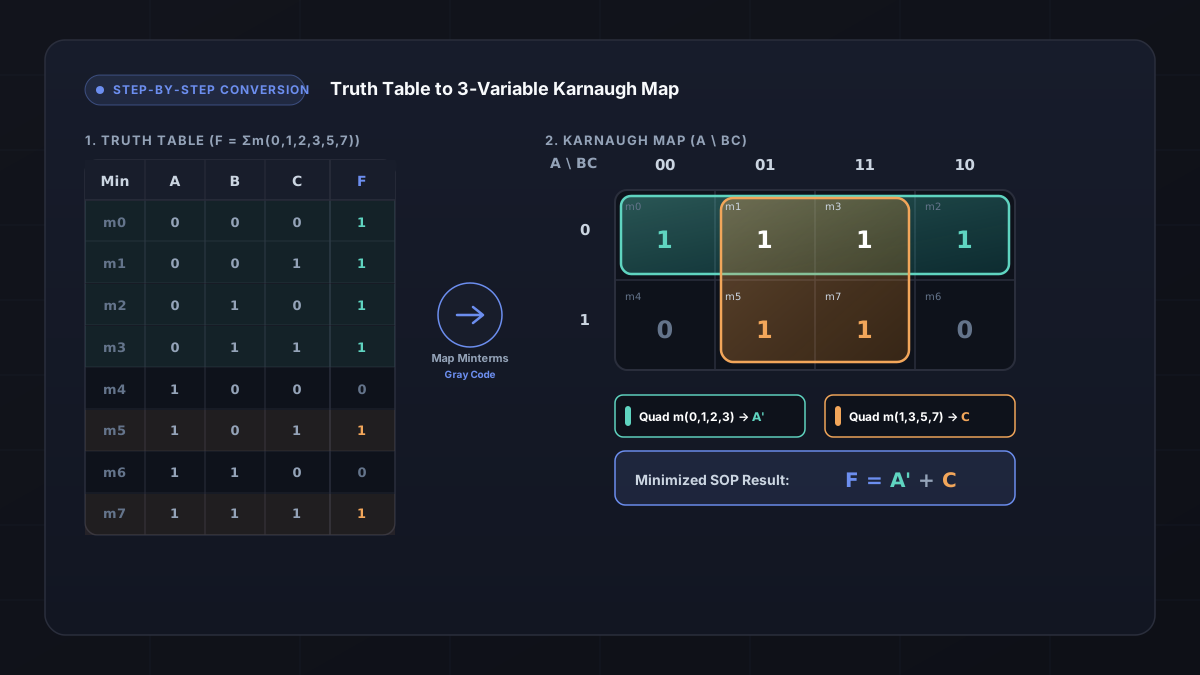
For example, it might be part of one horizontal quad and another vertical quad. That is not a mistake. Overlap is often useful because it lets you create larger groups or cover a difficult cell without settling for a smaller group.
The article on how to convert a truth table to a Karnaugh Map shows a concrete example where two quads share cells.
Rule 4: Opposite Edges Are Adjacent
A K-Map is drawn as a flat rectangle, but its Gray-code layout means opposite edges are logically adjacent.
- The left edge connects to the right edge.
- The top edge connects to the bottom edge.
A cell in the leftmost column can therefore form a pair with the corresponding cell in the rightmost column of the same logical row. The same principle applies vertically.
Rule 5: The Four Corners Can Form One Group
In a 4-variable K-Map, the four corner cells can form a valid quad.
This happens because wrap-around works in both directions at once. The left and right edges connect. The top and bottom edges connect. The four corners sit where those two wrap-around relationships meet.
The corners are NOT grouped because diagonal cells are adjacent. Diagonal adjacency does not exist in a normal K-Map. They form one group because of edge wrap-around.
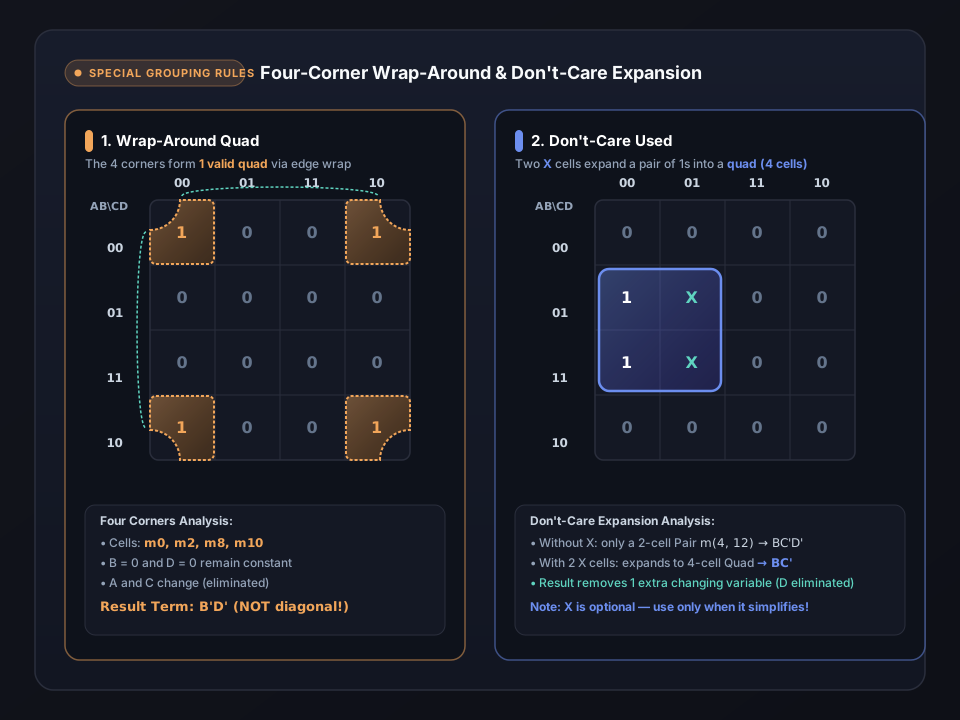
The four corners connect through edge wrap-around, not diagonal adjacency; don't-care cells can join a group when they help create a larger valid block.
Rule 6: Diagonal Cells Are Not Adjacent
Two cells that only touch at a corner point are not adjacent on a K-Map.
Even if both contain 1, they cannot form a pair by themselves. Gray-code adjacency works horizontally and vertically, including legitimate wrap-around connections. It does not create diagonal neighbors.
Rule 7: Groups Must Be Rectangular
Valid group shapes can include:
- 1×2
- 2×1
- 1×4
- 4×1
- 2×2
- 2×4
- 4×2
- 4×4
depending on the map size and available cells.
A group may cross an edge and still be logically rectangular because opposite edges are adjacent.
Invalid examples include:
- L-shapes
- T-shapes
- three-cell clusters
- diagonal patterns
Those shapes do not correspond to proper elimination of changing variables.
Rule 8: Do Not Include the Wrong Required Values
For SOP, a group cannot contain a required 0.
Every cell in an SOP group must be:
- a required 1
- or a usable don't-care X
For POS, the rule reverses. A POS zero-group cannot contain a required 1. It may contain required 0s and useful X cells.
Including an opposite required value produces an expression that no longer matches the original function.
How Don't-Care Values Affect Grouping
A don't-care cell is marked X. To explore worked examples and when to use or ignore X values, see our guide on don't-care conditions in Karnaugh Maps.
For SOP, an X may be treated like 1 when doing so creates a useful larger group. For POS, it may be treated like 0. It may also be ignored completely.
The X is optional.
For example, suppose two adjacent required 1 cells sit beside two X cells. If all four cells form a valid quad, using the X cells lets the pair expand into a quad. That larger group removes an additional changing variable.
If the X cells do not improve the grouping, there is no reason to use them.
Pairs, Quads, and Octets
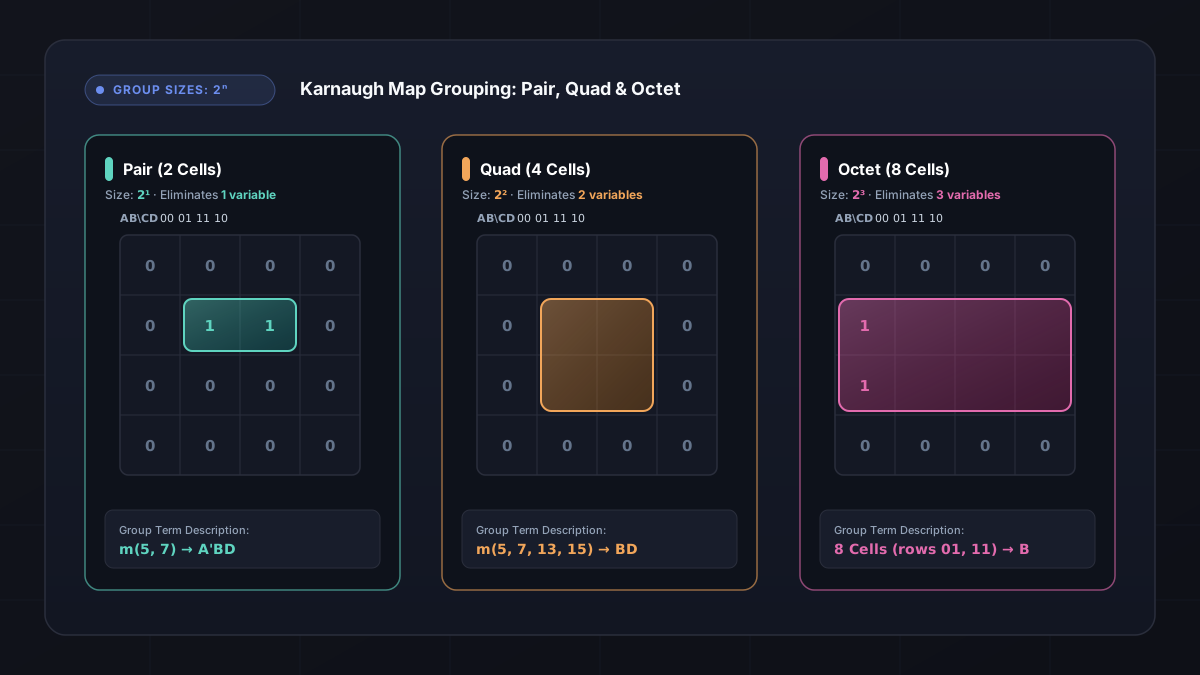
Pair
A pair contains two adjacent cells. One variable changes between the cells. The other variables remain fixed and survive in the simplified term.
Quad
A quad contains four valid adjacent cells. Two variables change across the group.
A quad may appear as:
- a row of four
- a column of four
- a 2×2 block
- a valid wrap-around block
The four corners of a 4-variable K-Map are one example of a wrap-around quad.
Octet
An octet contains eight valid cells. Three variables change across the group. Because three changing variables disappear, an octet often produces a very short term.
A Worked 4-Variable Grouping Example
Consider:
F(A, B, C, D) = Σm(0, 2, 5, 7, 8, 10, 13, 15)
Use a standard 4-variable K-Map with rows AB and columns CD, both ordered using Gray code:
00, 01, 11, 10
Two clean quads cover the function.
The first group contains the four corner minterms:
m0, m2, m8, m10
Across those four cells:
- B = 0
- D = 0
- A changes.
- C changes.
Therefore the group produces:
B'D'
These four cells form a group through horizontal and vertical wrap-around.
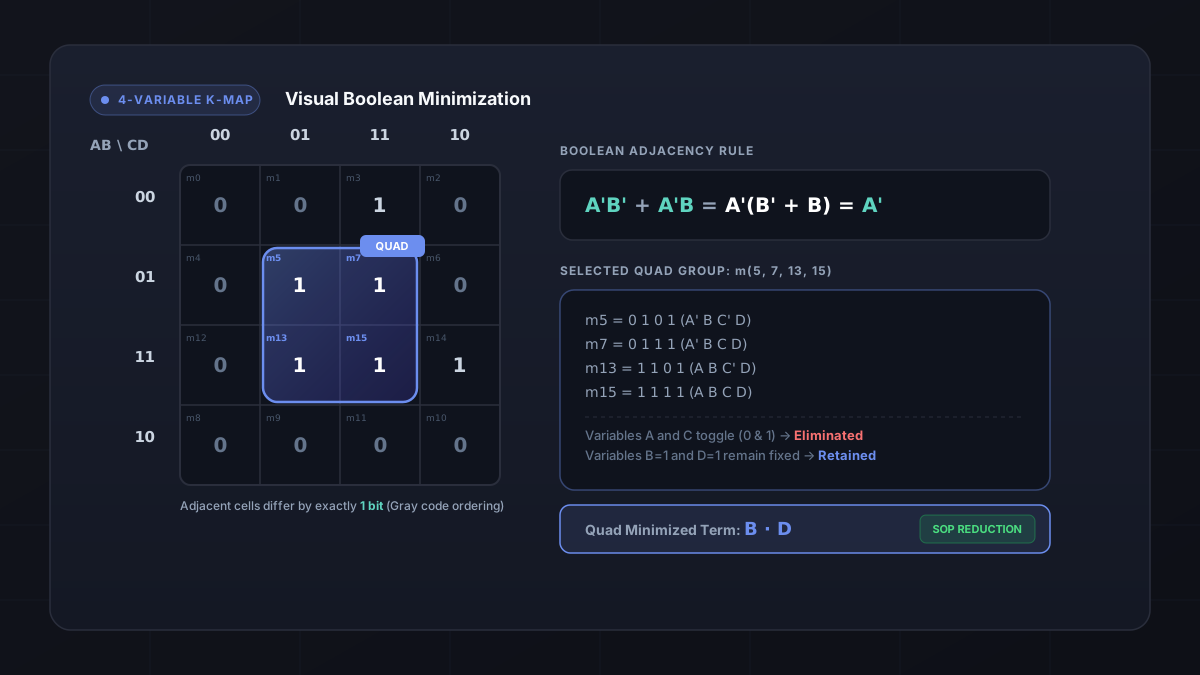
The second group contains:
m5, m7, m13, m15
This is a normal 2×2 quad.
Across these cells:
- B = 1
- D = 1
- A changes.
- C changes.
Therefore:
BD
Together the two groups cover all eight required minterms.
The simplified expression is:
F = B'D' + BD
No overlap is needed in this example.
Prime Implicants and Essential Prime Implicants
A prime implicant is a valid group that cannot be enlarged without including a cell that is not allowed. For example, an SOP group cannot be enlarged through a required 0.
An essential prime implicant is a prime implicant that covers at least one required cell no other prime implicant covers. Because that cell has no alternative coverage, the essential prime implicant must appear in the final cover.
Beyond the essential groups, more than one valid combination may sometimes cover the remaining cells. To learn how a prime implicant chart systematically identifies unique coverage and minimal covers, explore our detailed guide on prime implicants. That is why different but equally minimal expressions can occasionally exist for the same function.
Grouping Rules for SOP vs POS
The geometric grouping rules do not change between SOP and POS. The target cells change.
- For SOP: group the required 1s.
- For POS: group the required 0s.
Don't-care X cells may help either method. Power-of-two sizing, adjacency, overlap, rectangular shapes, and edge wrap-around apply in both cases.
Common Grouping Mistakes
- Forming groups of 3, 6, or another non-power-of-two size.
- Treating diagonal cells as adjacent.
- Forgetting wrap-around along opposite edges.
- Settling for a smaller group when a better larger group is available.
- Refusing to overlap groups when overlap improves the cover.
- Using an X merely because it exists, even when it gives no benefit.
- Treating a don't-care as a required value.
- Including a required 0 inside an SOP group.
- Including a required 1 inside a POS group.
- Mixing SOP and POS grouping logic.
- Assuming corner grouping works because of diagonal adjacency instead of wrap-around.
Quick Grouping Checklist
- Decide whether you are working in SOP or POS.
- Identify the required 1s or required 0s.
- Note the don't-care cells.
- Look for useful large power-of-two groups.
- Check opposite-edge adjacency.
- Allow overlap when it improves the cover.
- Make sure every required target cell is covered.
- Derive each term from the variables that remain constant.
- Check whether another valid cover uses fewer terms or literals.
Verifying a Manual Grouping
These rules become much easier once the map itself is familiar.
If needed, read what a Karnaugh Map is first.
After grouping a map manually, you can also compare the result with the Karnaugh Map Solver.
This is especially useful on 4- and 5-variable maps where wrap-around, overlap, and multiple possible covers can make a visual check harder.
Frequently Asked Questions
What sizes can K-Map groups be?
Valid group sizes are powers of two: 1, 2, 4, 8, and 16 cells. A 5-variable map can also use a 32-cell group when all 32 cells are eligible for that grouping.
Can K-Map groups overlap?
Yes. A cell may belong to more than one group, and overlap is often useful when it allows larger or simpler groups.
Can K-Map groups wrap around the edges?
Yes. The left and right edges are logically adjacent, and the top and bottom edges are logically adjacent.
Are diagonal K-Map cells adjacent?
No. Cells that only touch at a corner are not adjacent.
Can the four corners form one group?
Yes. In a 4-variable map, the four corners can form a quad because both pairs of opposite edges wrap around. It is not diagonal adjacency.
Do I have to use every don't-care value?
No. An X is optional. Use it when it helps create a better valid group; otherwise, leave it unused.
Getting these rules right becomes much quicker with practice. Once wrap-around and overlap stop feeling like exceptions, most grouping decisions become much easier.