An X on a Karnaugh Map does not mean 1, and it does not mean 0. It means the output for that input combination is not required, so the cell can be used whichever way helps the simplification — or ignored completely.
Misusing X values is a common source of K-Map errors. The key is understanding that a don't-care gives you flexibility; it does not create another required output that has to be grouped.
What Is a Don't-Care Condition?
A don't-care condition marks an input combination where the output is unspecified or irrelevant.
That might happen because the combination never occurs in the real system, or because either output value would be acceptable for that state.
This extra freedom can help produce a simpler Boolean expression. If you are new to K-Maps, you can first review what a Karnaugh Map is.
An X is not automatically part of a group. Depending on the form being simplified, it may be used as 1, used as 0, or left unused.
Why Do Don't-Care Conditions Exist?
Real digital systems sometimes contain input combinations that never appear.
One common example is Binary-Coded Decimal, or BCD. Four bits can represent sixteen binary combinations, but ordinary BCD only uses the patterns for decimal digits 0 through 9.
The binary values representing decimal 10 through 15 are therefore unused in normal BCD input.
When the output for an unused state is irrelevant, that combination can sometimes be marked as a don't-care.
Other situations can include unused state-machine states, impossible input combinations, or outputs whose values are irrelevant under specific conditions.
What Does X Mean in SOP?
For Sum-of-Products simplification, the required 1 cells are the targets.
Every required 1 must be covered by a valid group.
A required 0 cannot be included in an SOP group.
An X may be treated like 1 when it helps create a larger useful group, but it does not permanently become 1.
If the X gives no simplification benefit, leave it unused.
What Does X Mean in POS?
For Product-of-Sums, the process works from the required 0 cells.
Every required 0 must be covered.
A required 1 cannot appear inside a POS zero-group.
An X may be used like 0 if doing so creates a better valid group. Otherwise, ignore it.
The same X therefore gives flexibility in either form without having a permanently assigned output.
The Main Rule: Use X Only When It Helps
The useful question is not "Can I use this X?"
The better question is "Does using this X make the expression simpler?"
An X can be useful when it:
- turns a pair into a quad
- turns a quad into an octet
- removes another changing variable
- reduces the number of terms
- reduces the total number of literals
If none of those improvements happen, there is usually no reason to include it.
Do not force every X into a group.
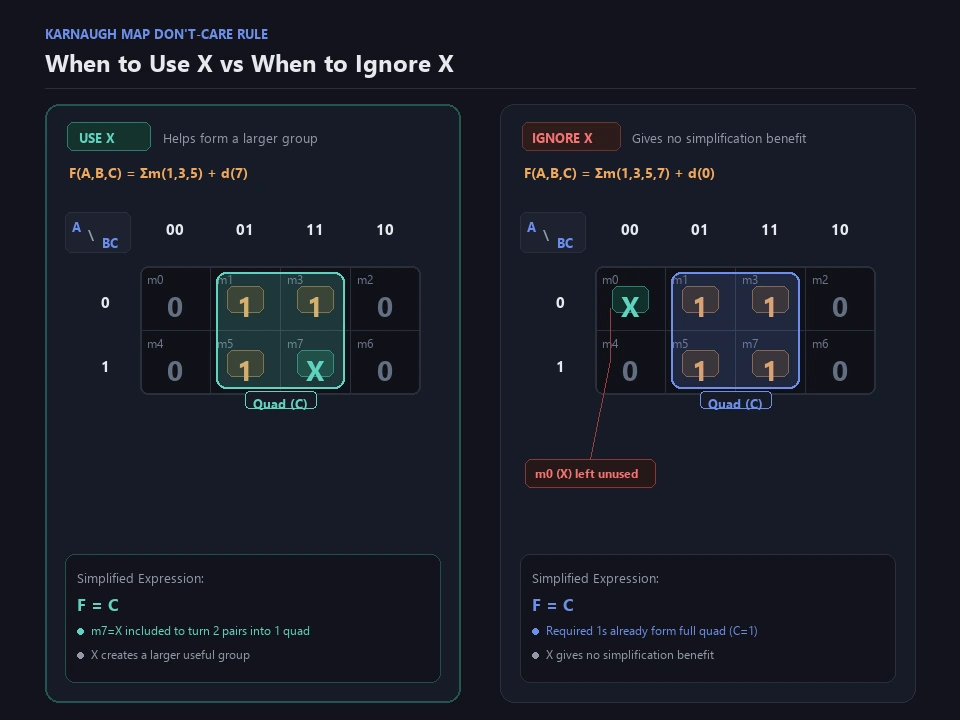
X values are optional tools: use one when it creates a better valid group, and ignore it when it changes nothing.
Worked SOP Example with Don't-Care Values
Consider:
F(A,B,C) = Σm(1,3,5) + d(7)
Here:
m1, m3, and m5 are required 1s.
d(7) means minterm 7 is a don't-care condition.
Using a 3-variable K-Map with rows for A and Gray-code columns for BC, the required 1 cells are:
m1
m3
m5
and m7 is marked X.
Without using the don't-care, two pairs are needed.
The pair:
m1,m3
keeps:
A = 0 C = 1
while B changes.
That produces:
A'C
Another pair:
m1,m5
keeps:
B = 0 C = 1
while A changes.
That produces:
B'C
Without using X, one valid result is:
F = A'C + B'C
Now use the don't-care at m7.
The cells:
m1,m3,m5,m7
form one valid quad.
Across all four cells:
C = 1
while A and B both change.
The quad therefore simplifies to:
C
The simpler result is:
F = C
This is valid because every required input still has the correct output.
The don't-care state m7 is allowed to become 1 in the simplified implementation because its original output was intentionally unspecified.
A Case Where You Should Ignore X
Not every X improves a function.
Consider:
F(A,B,C) = Σm(1,3,5,7) + d(0)
The four required 1s:
m1,m3,m5,m7
already form the complete group where:
C = 1
That simplifies directly to:
F = C
The don't-care at m0 cannot enlarge that group into a better valid group or remove another variable.
Using it gives no benefit, so it should simply be left unused.
Can Don't-Care Cells Form a Group by Themselves?
A group containing only X cells does not help cover any required output.
For SOP, groups are created to cover required 1 cells.
For POS, groups are created to cover required 0 cells.
A collection of only don't-care cells would add a term that is not needed to represent the required behavior of the function.
Use X cells to improve groups that matter rather than creating unnecessary groups from X values alone.
Don't-Care Values and Group Size
Don't-care cells become useful when they help create a larger valid power-of-two group.
For example:
a pair may become a quad
or:
a quad may become an octet
The larger group can eliminate another changing variable and produce a shorter term.
The normal Karnaugh Map grouping rules still apply.
An X does not allow an invalid group of three, five, or six cells.
Don't-Cares with Wrap-Around Groups
Don't-care cells can also participate in legitimate wrap-around groups.
For example, a required 1 near the left edge and an X in the corresponding logical position on the right edge may form a pair because opposite K-Map edges are adjacent.
The ordinary adjacency rules still apply.
The presence of X does not make unrelated cells neighbors.
Common Don't-Care Mistakes
Treating every X as 1
Some X cells provide no useful SOP grouping at all.
Forcing every X into a group
A don't-care is optional. Leave it unused when it does not improve the result.
Creating groups made only from X cells
Such a group does not help cover required behavior.
Including a required 0 in an SOP group
An X does not make required 0 cells eligible for grouping with 1s.
Including a required 1 in a POS group
The reverse restriction applies when grouping zeros.
Breaking the power-of-two rule
X cells do not make groups of 3 or 6 valid.
Forgetting to cover required cells
Don't-cares add flexibility, but all required target cells still have to be covered.
Don't-Care Conditions in 4- and 5-Variable K-Maps
The principle does not change as the number of variables increases.
A 4-variable map contains 16 cells, while a 5-variable function has 32 possible input combinations.
With more cells, there may be more opportunities for X values to turn small groups into larger ones.
Manual checking also becomes harder, especially when wrap-around, overlap, and several don't-care cells appear at the same time.
The same rules still apply:
use X only when useful, keep groups power-of-two sized, and make sure every required target cell is covered.
How to Check a Result with Don't-Care Values
When verifying a simplified expression, compare it with every required non-X input from the original function.
Those outputs must match.
You do not need the final expression to reproduce one particular output for a don't-care combination because that output was never required in the first place.
For the worked example above:
F = C
must correctly reproduce the required outputs for m1, m3, and m5 and the required zeros.
Its value at m7 does not need to match an original 0 or 1 because m7 was marked as a don't-care.
You can also compare a manual solution with the Karnaugh Map Solver.
Frequently Asked Questions
What does X mean in a Karnaugh Map?
X marks an input combination whose output is unspecified or irrelevant. It may be used when it helps simplify the function, or ignored when it does not.
Is X treated as 0 or 1 in a K-Map?
It is not permanently either value. For SOP it may be used like 1 when helpful, and for POS it may be used like 0. It can also remain unused.
Do I have to use every don't-care condition?
No. Use an X only when it improves a valid grouping or simplifies the final expression.
Can a don't-care be included in an SOP group?
Yes. It can be used like 1 when doing so helps create a larger valid group containing required 1 cells.
Can a don't-care be included in a POS group?
Yes. It can be used like 0 when that helps create a larger valid group containing required 0 cells.
Do don't-care values need to match the final expression?
No. The simplified function needs to match all required non-X outputs. Don't-care outputs were intentionally left unspecified.